Every successful volleyball tournament begins long before the first whistle. It starts with intentional planning, thoughtful scheduling, and a commitment to creating an exceptional experience for every athlete, coach, official, and family. Those principles have guided the Ohio Volleyball Association (OVA) since its founding in 2021 and continue to shape every event it hosts.
Founded by brothers John and Jeff Ferguson in partnership with longtime JVA member Adam Evans, the Ohio Volleyball Association was created to fill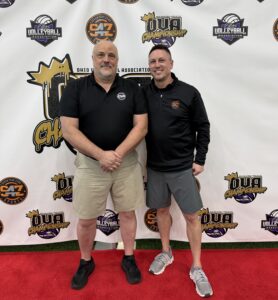 an important gap in the junior volleyball tournament landscape. Drawing on more than two decades of experience organizing large-scale basketball events and Evans’ extensive background as a volleyball parent, coach, official, and tournament director, the organization set out to provide high-quality tournaments for the many club teams that may not travel nationally but still deserve a first-class competitive experience.
The idea for OVA was born during an unexpected pause in the Fergusons’ event business.
John and Jeff had been involved in youth basketball events for more than 25 years, beginning with the Girls Basketball Association (GBA) in 2003 and later expanding their work through Ohio Hoops Basketball (OHB), which was founded in 2016. Their experience had taught them how to build events around more than just competition—they understood the importance of facilities, scheduling, communication, hospitality, and creating an experience that works for athletes and families.
When COVID-19 brought youth sporting events to a halt in 2020, the brothers began discussing how they could expand their sports business.
“We started having conversations about expanding our sports business and creating opportunities in another sport,” John explained. “We wanted to take the model we had developed over the years and apply it to volleyball—not just for the elite athletes, but for everyone.”
That vision led to the formation of OVA in 2021.
There was one challenge: neither John nor Jeff came from a traditional volleyball background. Their connection to the sport was primarily through John’s wife, Tera, a standout high school and collegiate volleyball player.
That’s where Evans entered the picture.
The brothers were introduced to Adam through a mutual friend and quickly recognized that his experience and philosophy aligned with their vision for OVA.
“Adam brought the volleyball knowledge and perspective that we needed,” John said. “We very quickly determined that he was a great fit for what we wanted to build.”
The partnership brought together complementary strengths: decades of event management experience from the Fergusons and a deep understanding of the volleyball experience from Evans.
Now entering its sixth year, OVA continues to grow, evolve and refine its events while providing opportunities for youth volleyball teams and clubs throughout Ohio and neighboring states.
A Volleyball Dad’s Perspective
For Adam Evans, the journey into tournament management began long before he ever sat behind a tournament desk.
His daughter, Kacie, was around volleyball before she was even born, with her mother coaching a high school team during her pregnancy. As Kacie grew, so did her love and ability for the sport.
Adam experienced volleyball from nearly every possible perspective—as a player, coach, parent, spectator, official, and eventually tournament director. Each role gave him a different understanding of what makes an event successful.
From the bleachers, he noticed things that were easy to overlook from the competition floor.
“I learned from the spectator side of things what makes a good tournament,” Evans said. “Parents don’t want to spend an entire day in the gym if they don’t have to. Coaches appreciate formats that keep teams playing consistently without long breaks or unnecessary downtime. Those experiences influenced nearly every decision we’ve made.”
Ample seating, room to move between courts, convenient access to concessions and restaurants, efficient schedules, and limited downtime all became part of Adam’s vision for what a tournament could—and should—be.
His experience as a coach added another layer. He knew that formats requiring teams to officiate and then immediately play, lengthy breaks between matches, or back-to-back matches during pool play could negatively affect the experience for both athletes and coaches.
Having attended and coached at USAV National Championships, Adam had seen formats that worked particularly well, including six- and eight-team pools where teams played every other hour and did not officiate matches within their own pool.
He wanted to find a way to bring some of those same benefits to smaller events.
Solving Problems Through Innovation
One of the defining characteristics of OVA tournaments is the intentional thought that goes into scheduling and competition formats.
Evans spent countless hours designing new pool-play formats to eliminate many of the frustrations coaches and families commonly experience. Every adjustment began with the same question:
How can we make the experience better?
One innovation allows four-team pools to compete every other hour on neighboring courts without teams officiating matches within their own pool. Each court can operate independently while teams remain active without excessive downtime. OVA has now successfully implemented the format for several seasons.
Another challenge involved the common three-team pool format, where shortened matches can create an uneven competitive experience and potentially eliminate teams before they have had the opportunity to play a traditional match.
Rather than accepting the limitations of the format, Evans continued searching for a solution.
“I’ve always had a strong desire to make events better for all teams and fix issues that I thought were fixable,” Evans said.
After considerable thought and experimentation, OVA developed a format that allowed teams to avoid the shortened three-team pool structure and instead play standard 25-25-15 matches. The organization implemented the new format at two events late in the 2026 season and continues to evaluate and refine it.
The philosophy behind those changes is simple: if there is a better way to serve the athletes, coaches and families, OVA wants to find it.
That same philosophy is reflected in one of OVA’s clearest guiding principles for its one-day events:
Teams should not spend more than eight hours total in the gym.
That means fewer hours sitting in folding chairs, fewer lengthy breaks between matches, and more time competing instead of waiting.
It’s a seemingly small detail, but one that can have a significant impact on the overall tournament experience.
Finding the Right Fit
While many tournaments focus on attracting teams traveling across the country to pursue national championship opportunities, OVA intentionally serves another important segment of junior volleyball.
 “We wanted to create events for everyone, not just the elite athletes,” John said. “There are a lot of teams and clubs that are very competitive but aren’t getting on planes every weekend. We saw an opportunity to give those teams a great experience closer to home.”
OVA’s target audience includes small- and mid-sized clubs, as well as second-, third- and fourth-level teams within larger organizations.
The goal isn’t to compete with large national events. It’s to create a different kind of opportunity.
“We want to provide a ‘big-time’ tournament feel for teams that don’t want to travel extensively,” Evans said. “There are so many highly competitive teams that deserve a great tournament experience closer to home.”
That philosophy has resonated with clubs throughout Ohio and neighboring states.
Today, OVA has established seven consistent annual events and continues to explore opportunities to add additional venues and tournaments while maintaining the quality standards that have become central to its brand.
Finding suitable facilities and dates remains one of the organization’s greatest challenges. With tournament operators competing for venues and teams every weekend of the season, securing the right location at the right time requires persistence and creativity.
“We’ve been able to add events by reaching out to venues and by taking advantage of people who have contacted us about running events,” Evans said. “Being persistent and always looking for new places and opportunities has allowed us to grow.”
A Partnership Built on Complementary Strengths
The success of OVA is also a reflection of the partnership between the Fergusons and Evans.
John and Jeff brought decades of experience in youth sports event management. Adam brought an understanding of volleyball from virtually every angle.
John describes the partnership with his brother in simple terms: Jeff has historically been the visionary, while John focuses on turning those ideas into reality.
That combination has helped the organization grow beyond OVA as well. In 2022, the brothers founded S4Z Sports (Seven4Zero Sports), which now serves as the umbrella organization for their youth sports and events.
The OVA partnership follows that same philosophy—combine different strengths and experiences to create something better than any one person could build alone.
Relationships Drive Success
While innovative scheduling has helped distinguish OVA tournaments, Evans believes the organization’s greatest strength has little to do with brackets or software.
It’s the people.
From working alongside John and Jeff and a dedicated event staff to partnering with experienced officials and reconnecting with Club Directors each weekend, relationships remain at the heart of every tournament.
“I really enjoy working with the people,” Evans said. “We’ve developed a lot of great relationships with our officiating cadre, the clubs and the coaches. I look forward to seeing coaches and directors that I’ve communicated with leading up to the events and spending time with them face to face.”
That philosophy extends to the athletes and families as well.
Evans sees players not only competing on the court but also interacting with the tournament staff and officials as they fulfill work-team responsibilities. He enjoys watching the growth of players and seeing the skill and athleticism that today’s young athletes bring to the sport.
And while spectators can occasionally present challenges, Evans keeps the bigger picture in mind.
“I always remind myself that we do this for the people so that they can have a great time and enjoy this part of their lives.”
That perspective is at the core of OVA’s approach to event management.
The Value of the JVA Community
As a longtime JVA member, OVA has also benefited from the association’s educational resources, tournament promotion, and collaborative network of experienced event operators.
“The JVA has been very helpful in terms of helping us promote events and answering any questions we had,” Evans said.
For a growing tournament organization, having access to resources and a broader volleyball community provides another avenue for learning and development.
As OVA continues to grow, that willingness to learn remains an important part of its philosophy.
Looking Ahead
As the junior volleyball tournament landscape continues to evolve, John and Adam believe organizations that prioritize the participant experience will ultimately stand out.
With more events competing for teams than ever before, clubs have choices. Increasingly, those decisions come down to organization, communication, quality officiating, efficient scheduling, strong facilities, and an environment where athletes can compete at their best.
OVA’s goal isn’t simply to add more tournaments. It’s to continue improving the tournaments it already offers and thoughtfully expand when the right opportunities arise.
“We’re entering our sixth year, and every year we’ve grown, learned, created and expanded,” John said. “Our goal is to continue providing wonderful playing opportunities for youth volleyball teams and clubs across multiple states.”
That philosophy has become the foundation of the Ohio Volleyball Association.
By combining decades of youth sports event experience, volleyball-specific expertise, innovative tournament formats, strong partnerships, quality venues, and a relentless focus on the participant experience, OVA continues to demonstrate that some of the biggest improvements in junior volleyball don’t come from changing the game itself—they come from improving everything that surrounds it.
View more information on running a JVA insured tournament.