Most directors are constantly juggling tasks that pull them in ten directions at once—parent communication, scheduling, registrations, coach coordination, tournaments, and marketing.
In 2025, Dennis Yu and Dylan Haugen presented at the JVA Align Volleyball Summit to show volleyball club directors and administrators how AI can support digital marketing and day-to-day operations without adding more staff hours. The clubs that win aren’t always the ones with the biggest staff—they’re the ones that build systems to handle the repeatable work without burning out their team.
That’s where agentic AI and Custom GPTs come in.
As co-founders of Local Service Spotlight, they teach a simple way to think about AI: not as complicated technology, but as “digital employees.” These AI employees can handle consistent, repeatable tasks—while the director stays focused on leadership, athletes, and real relationships.
These concepts are also taught through their coaching program in partnership with High Rise Influence, helping organizations publish more content, strengthen communication, and stay visible online without burning out.
This approach is especially helpful for volleyball organizations, where the same questions, updates, deadlines, and logistics happen over and over again every season. AI is most effective when it’s not treated as a replacement for staff, but as support for the repetitive tasks that pull leaders away from coaching, culture, and operations.
What Is Agentic AI (In Plain English)?
Agentic AI is AI that can act more like a team member than a basic chatbot. Instead of just answering one question, an “agent” can take a goal and help complete a task from start to finish—step-by-step—while following instructions and standards.
For volleyball clubs, this means AI can assist with things like:
- drafting parent newsletter updates (with consistent tone and clear next steps)
- summarizing long email threads into a quick “what happened + what to do next” recap
- turning coach notes, schedules, and program details into clean web page copy (so information isn’t trapped in documents)
- repurposing a short video or post-game interview into: a blog post, captions, quotes, and a newsletter update
- identifying the missing FAQs and objections on key enrollment pages (and drafting answers)
- auditing the club website and implementing basic SEO + performance updates (page speed, missing titles/meta, broken links, weak or thin pages)
Instead of guessing what to do next, directors can treat AI like a staff member and assign work the same way they would delegate to an assistant.
How To Use Agentic AI In ChatGPT (Step-By-Step)
After a director understands what agentic AI is, the next question is simple: what does it look like to actually use it during a normal week?
The easiest way to start is to open ChatGPT, open a few key tabs, and assign tasks the same way you’d assign them to staff.
Option A: Use ChatGPT’s Browser Agent (Atlas)
If you have access to Atlas, this is the most natural way to see agentic AI in action because the AI can work in a browsing environment while you keep multiple tabs open.
- Open ChatGPT Atlas in your browser.
- Open your working tabs (each tab becomes a “task station”):
- Tab 1: your club website (tryouts / camps / clinics)
- Tab 2: a Google Doc with program details or schedules
- Tab 3: your newsletter draft
- Tab 4: your social feed (recent event recap)
- Assign one task per tab so the AI stays focused:
- Website tab: “Audit this page for basic SEO + performance fixes and list the top updates.”
- Doc tab: “Turn these notes into clean website copy parents can understand.”
- Newsletter tab: “Draft this week’s newsletter update with reminders and next steps.”
- Social tab: “Draft a social post based on this recent event.”
- Run tasks in parallel. With multiple tabs open, you can have multiple agents producing drafts at the same time—while you manage and monitor the whole “team” like a director.
- Review and approve. Keep what works, edit what needs polishing, and reuse tasks that work well.
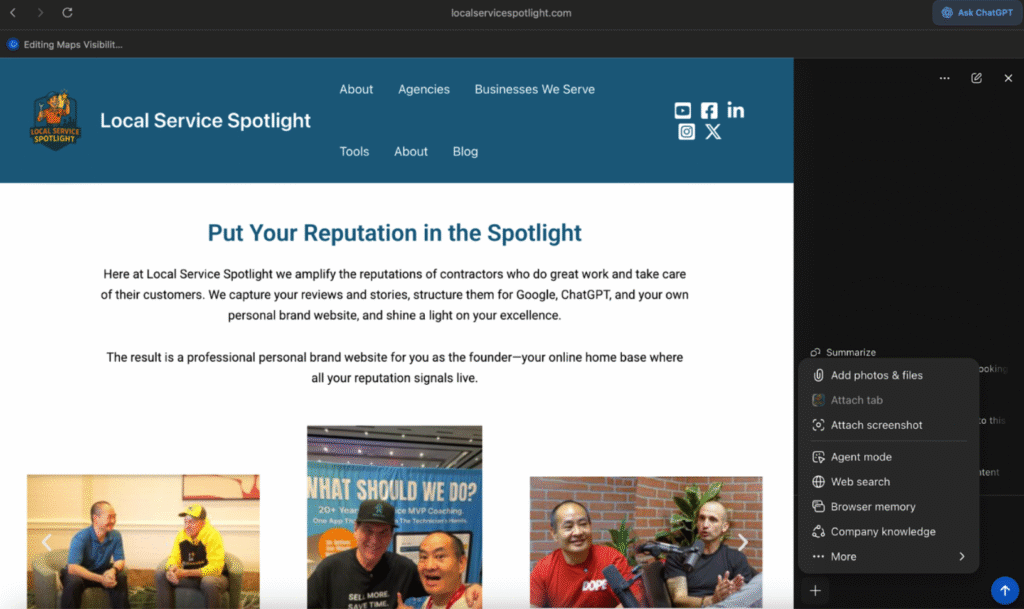
How to activate Agent Mode within ChatGPT Atlas
Option B: Use ChatGPT Agent Mode (Built Into ChatGPT)
If you don’t have Atlas, directors can still use agentic AI inside ChatGPT by turning on Agent Mode. Instead of working inside your browser tabs, ChatGPT opens its own browser window and may ask you to sign in so it can help complete tasks in the right places.
Custom GPTs: Why “Employees” Beat One Generic Chatbot
Most directors have already tried tools like ChatGPT for quick writing help. The problem is that generic AI often gives generic output.
A Custom GPT solves this by being trained for a specific role—just like hiring someone for one job instead of asking one person to do everything.
Dennis and Dylan explain it like this:
If a club hired a staff member and told them to do social media, write newsletters, build the website, and create schedules all at once, it would be chaos. But when each person has a clear responsibility, the operation runs smoother.
Custom GPTs work the same way.
At BlitzMetrics, Dennis and his team have created multiple Custom GPTs that work like specialized staff. A few examples include:
- Jennifer (Article Quality Grader): reviews content and gives structured feedback before it gets published
- Brandon (Blog Post Helper): turns video transcripts into structured blog posts with headings and SEO basics
- Stephanie (Operations Assistant): provides step-by-step guidance for admin tasks and internal processes
- Ethan (Positive Mentions Assistant): identifies online mentions and organizes them into categories that support reputation
- Olivia (Knowledge Panel Helper): supports building authority and improving online trust signals
- Christopher (Website Auditor): flags issues affecting local visibility, structure, and technical health
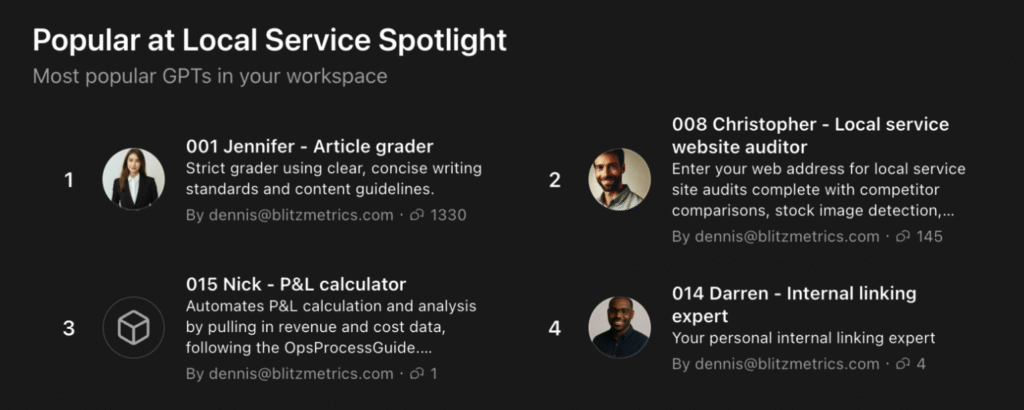
Some examples of the Custom GPTs at Local Service Spotlight
Volleyball clubs don’t need these exact tools to benefit from the concept. The key is the model: create a small “staff” of AI assistants that each have a job.
How To Create (And Train) A Custom GPT For Your Club
Creating Custom GPTs inside ChatGPT is available on paid plans such as ChatGPT Plus, Pro, Business, Enterprise, and Edu.
For club administrators, the practical takeaway is simple: once you’re on the right plan, building a Custom GPT is straightforward.
Inside ChatGPT, there is an option to explore GPTs and select Create. The creation screen is usually split into two parts:
- one side is a live preview of how the Custom GPT behaves
- the other side is where you edit and improve it
A director (or the club’s delegated “AI lead”) can build a Custom GPT by:
- Giving it a role (example: “Newsletter Assistant” or “Website Auditor”)
- Adding instructions that match the club’s tone and standards
- Uploading helpful documents (SOPs, program details, schedules, policies, templates)
- Training it through feedback by reviewing outputs and adjusting the instructions over time
This is less like programming and more like onboarding a new staff member.
Once a Custom GPT is performing well, it can be shared with other team members so multiple people can use the same “AI employee” across the organization.
The Simple Framework Volleyball Clubs Should Follow: GCT
To keep AI practical and useful (instead of overwhelming), Dennis and Dylan teach clubs to use GCT:
Goals
What result does the club want?
Examples:
- more tryout signups
- more camp registrations
- fewer repetitive parent questions
- faster communication and fewer last-minute issues
- higher visibility on Google and social media
- more proof of success shown online
A clear goal is what turns AI into a real assistant instead of a random writing tool.
Content
What “raw ingredients” already exist—or should be created—so they can be reused?
Most clubs already have what they need, or they can create it quickly:
- photos and short videos from practice or tournaments
- coach and player stories
- scholarship wins and success stories
- FAQs parents ask every season
- tryout details, schedules, and program overviews
AI works best when it’s repurposing real materials—not trying to invent content out of thin air.
Targeting
Who needs to see it, and where?
For volleyball clubs, the targets are usually:
- parents deciding where to spend money
- athletes considering joining
- coaches evaluating the program
- local searchers looking up “volleyball club near me”
Targeting determines where the content goes:
- website pages
- blog posts
- social posts
- YouTube videos
- newsletters
A Simple Example: “Newsletter + Proof” In 30 Minutes
One of the easiest ways for a club to start is to use AI to create a weekly or bi-weekly newsletter that’s built from real proof.
A director (or a delegated team member) can gather:
- 3 practice photos
- a short coach quote
- one upcoming tournament schedule
- one player highlight
- one key deadline
Then ask a Custom GPT:
“Turn these notes into a newsletter update for parents. Keep it organized, positive, and clear. Include next steps and reminders.”
This produces a draft that can be reviewed in minutes, while still sounding like the club.
The Most Practical First Step For Directors
The fastest win is to pick one job and assign it to one AI employee.
A great starting point for most clubs is:
AI Newsletter Assistant
Because once the club’s communication becomes faster and clearer, everything else gets easier:
- fewer misunderstandings
- less admin stress
- more consistency across staff
- better parent experience
From there, clubs can add AI employees to help with content repurposing and website improvements.
Agentic AI and Custom GPTs won’t replace directors or coaches. What they will do is take pressure off the parts of the job that don’t require a director’s brain.
When volleyball clubs treat AI like a team of employees—with clear roles, clear instructions, and real content to work from—they gain time, consistency, and visibility without needing to hire more staff.
Dennis Yu and Dylan Haugen apply these systems through Local Service Spotlight and teach them through their coaching program at High Rise Influence, helping organizations build a repeatable structure for communication and growth—starting with the simplest step: delegate the busywork, and keep humans focused on leadership and relationships.
Looking ahead, the 2026 JVA Align Volleyball Summit will take place May 12–13, 2026 in Dallas, Texas, and Dennis and Dylan will be back to go deeper on how volleyball clubs can use AI and digital marketing to grow their programs, strengthen communication, and make their proof more visible online. Register now.