As Iowa Select Volleyball Club enters its 10th year, the organization stands as a case study in intentional growth, reflective leadership, and a willingness to challenge long-standing norms in club volleyball.
Founded in 2016 as a four-team program operating out of a two-court church facility, Iowa Select has grown into a 28-team girls club with its own six-court training center. The club now hosts more than 30 tournaments annually, has over 100 alumni currently playing collegiate volleyball, and offers year-round auxiliary programming that serves athletes beyond the traditional club season.
One of the most impactful evolutions in Iowa Select’s history came not through expansion, but through subtraction.
Beginning in 2023, the club made a deliberate shift away from traditional large rosters in favor of a smaller, development-centered team model. This decision reshaped how teams trained and competed, and it fundamentally changed the organization’s approach to leadership, budgeting, coach sustainability, and long-term athlete development.
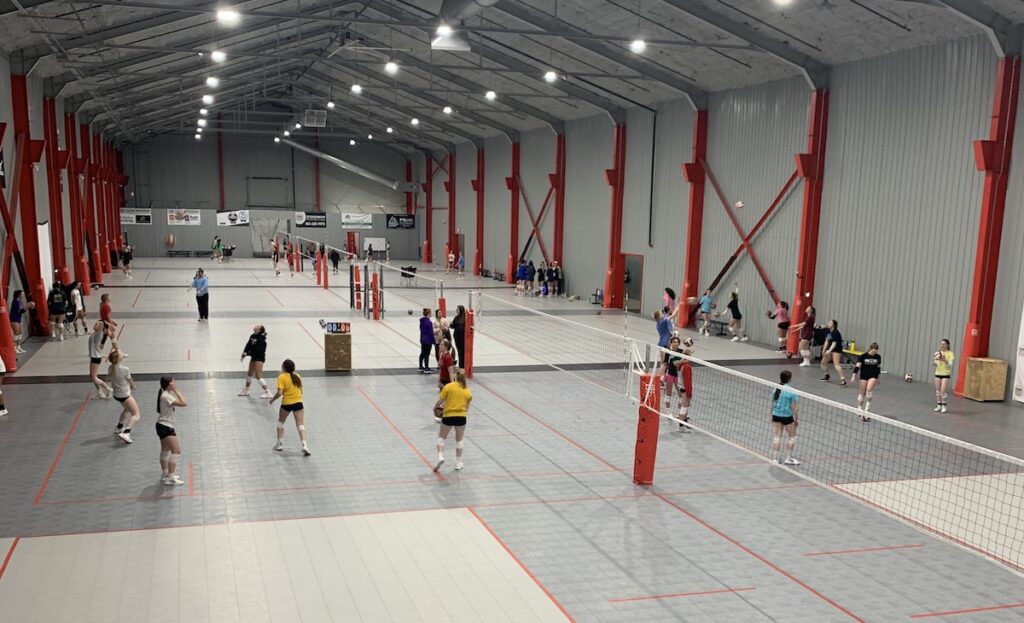
Iowa Select’s Quad City Volleyball Facility in Davenport, Iowa
Recognizing When the Structure No Longer Serves the Mission
From 2016 through 2022, Iowa Select rostered 10 to 11 athletes per team across all age groups. While this mirrored thestandard club volleyball model, leadership began to see a growing disconnect between developmental goals and daily realities, particularly on non-national teams.
Coaches spent disproportionate time managing playing time, expectations, and short-term satisfaction rather than teaching and developing athletes. Players on regional teams, intended as part of a developmental pathway, trained and competed on large rosters that limited meaningful reps, six-rotation opportunities, and true skill acquisition. At the same time, the club often pursued higher-level qualification for second teams, creating expectations misaligned with realistic developmental outcomes.
The conclusion was unavoidable. The structure itself was undermining development.
Rather than making incremental adjustments, Iowa Select reassessed where club volleyball fits within the athlete pathway and committed to a philosophical shift grounded in long-term growth.
The New Model: Smaller Rosters, Greater Responsibility
Under the new structure, national teams roster nine to 10 athletes for travel, while all other teams operate with eight-player rosters. These eight-player teams are intentionally designed for six-rotation development and typically include one setter, one libero, three pins, and three middle-pin hybrids.
Training is organized at the group level. Eight-player teams train together in shared sessions, with a maximum of 10 teams per block in the club’s six-court facility. This structure balances individual team work, positional training, and 6v6 play against comparable competition.
Each session is led by a Master Coach who designs the training plan and mentors the coaching staff. This leadership layer has become central to coach development and program-wide consistency.
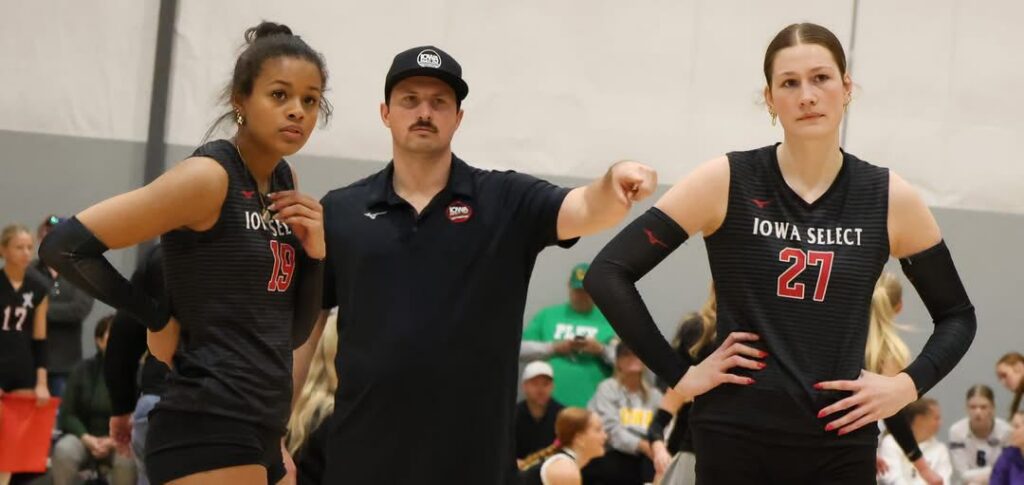
Director Frank Flanagan during a tournament
Coach Sustainability as a Strategic Priority
One of the most immediate outcomes of the transition has been improved coach sustainability.
By reducing constant playing-time management, coaches are no longer consumed by roster politics. Their focus has returned to teaching, training, and athlete development. Expectations are clearer, emotional fatigue is reduced, and coaches can invest in their own growth.
This shift has led to stronger staff retention, healthier gym environments, and a coaching culture aligned around development rather than conflict management.
Budget Realities: Value Over Volume
From a financial perspective, smaller rosters did not significantly disrupt the club’s budget, though they required clear communication with families.
Eight-player teams cost more per athlete than comparable teams with larger rosters elsewhere. Families generally understand that fewer athletes share operational expenses. In return, athletes receive more reps, increased responsibility, and consistent six-rotation experience, all of which are essential at the developmental level.
When the value proposition is clearly communicated, families recognize the direct impact on athlete growth and are willing to invest.
Smaller rosters do introduce operational challenges, including injuries, multi-sport conflicts, and practice efficiency. Iowa Select addressed these challenges by staggering competition schedules within age groups, allowing for internal subbing without overextending athletes or staff.
The club also created a Ready Program, a training group of 32 athletes in grades seven through 10 who train together, compete independently, and serve as a sub pool, along with athletes from the other teams. In 2025 alone, the Ready Program logged more than 200 sub appearances, significantly increasing playing opportunities across the club.
Culture First: Building a Club-Wide Identity
A smaller roster model depends on culture, and Iowa Select placed culture at the center of the transition.
From the outset, athletes and families are educated on the ecosystem they are joining. Subbing is positioned as a standard component of the model, not an exception. Because teams train together regularly, athletes are familiar with one another before subbing occurs in competition.
Communication is clear and proactive. Sub athletes are informed of their role in advance, minimizing confusion and preserving trust. When possible, subs train with the team during the week leading into competition to ensure continuity.
A core principle reinforces that athletes represent the club first, not just an individual team. This shared identity allows Iowa Select to create more playing opportunities while maintaining cohesion and reinforces that development occurs within a system.
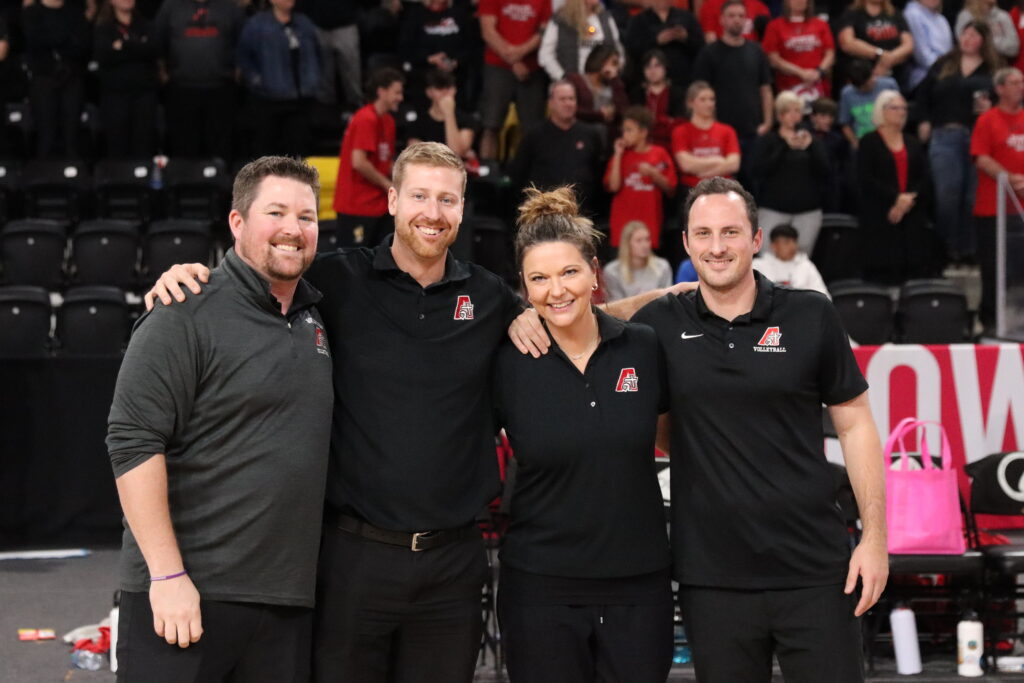
Iowa Select Co-Founder Kyle Condon (second from the left) and Co-Founder and Director Frank Flanagan (far right) after they won an Iowa High School Championship at Assumption High School in 2022
Leadership, Accountability, and Long-Term Buy-In
From a leadership standpoint, reduced playing-time conflict has been a major benefit. Coaches are empowered to coach, athletes are given real opportunity, and accountability becomes unavoidable.
For athletes, the model provides opportunity paired with responsibility. Increased reps do not guarantee progress. Athletes must rise to the challenge. Some adapt quickly, while others struggle with the added accountability. Iowa Select embraces this tension as a tool for honest conversations around habits, effort, and long-term goals.
Eight-player teams also function as a true internal feeder system. Rather than relying on external replacements, athletes develop versatility and experience that allow them to progress naturally. Internal movement builds trust in the system and validates the developmental pathway.
Lessons for Club Directors
For Club Directors considering a similar shift, Iowa Select leadership emphasizes clarity and conviction.
Smaller rosters must be implemented for development, not wins. Growth often includes discomfort, whether that means a middle training six rotations or a smaller setter learning to compete at the net. When expectations are clearly communicated and consistently supported, discomfort becomes part of the learning process rather than a source of conflict.
The value of the model lies in accelerated development. Athletes gain positional versatility, confidence across all rotations, and skills that translate directly to future opportunities. When leadership is aligned, communication is strong, and culture is prioritized, smaller rosters can fundamentally reshape athlete development within club volleyball.
View more club volleyball business resources.
Iowa Select Volleyball is a member of Junior Volleyball Association, an organization committed to enhancing the junior volleyball experience for Club Directors, Coaches, players, and fans.
Learn more about joining JVA.