On a summer day in a small coastal town in Spain, Finn Chapin surfaced from a pool and grabbed the edge as his world began to spin. What first appeared to be an isolated episode marked the beginning of a life-altering journey that would test his resilience, reshape his perspective, and ultimately return him to the volleyball court.
Nine months later, Finn is no longer defined by hospital rooms or treatment schedules. He is back with Pipeline Volleyball Club in Chicago, pursuing the game that first captured his attention in seventh grade.
“I started playing volleyball in seventh grade with a Pipeline season in the winter,” Finn said. “Before that, I was doing both soccer and taekwondo.”
Volleyball quickly became his focus. By the end of his freshman year, Finn committed fully, stepping away from other sports to pursue the one that felt right.
Not long after, subtle warning signs appeared.
At first, the symptoms were manageable. Morning headaches faded as the day progressed. Even when dizziness surfaced during the trip to Spain, it did not immediately signal a serious issue.
But the symptoms intensified.
“When we got home, the symptoms got worse,” Finn said. “I was waking up with severe headaches that felt like intense pressure in my head.”
His father, Wayne, recognized the shift.
“What changed was when the headaches progressed to include nausea and vomiting, and the symptoms became more intense and consistent,” he said. “That combination is what led us to take him to the ER.”
A scan revealed a brain tumor blocking the normal flow of cerebrospinal fluid, creating dangerous pressure.
The response was immediate.
The next day, Finn underwent emergency surgery to relieve the pressure. The procedure, an endoscopic third ventriculostomy, created a new pathway for fluid drainage. His symptoms improved quickly.
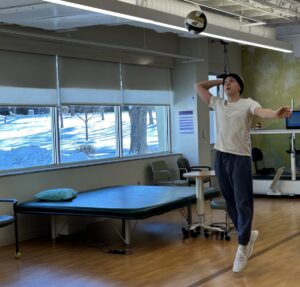
A biopsy followed. After two and a half weeks, doctors confirmed the diagnosis. Finn’s care team implemented a multi-phase treatment plan that includedchemotherapy to shrink the tumor, a 9.5-hour surgery to remove it, rehabilitation, six weeks of proton radiation, and ongoing maintenance chemotherapy.
Finn progressed through each phase.
Finn’s care team at Lurie Children’s Hospital played a tremendous role throughout his journey.
“Everyone at Lurie truly goes above and beyond, and their compassion and dedication make such a difference,” she said. “While I wish I could remember every single name, there are a few individuals who stand out.”
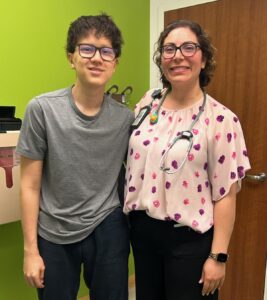 She specifically recognized Dr. Michael Decuypere and the neurosurgery team for their expertise and care, as well as Dr. Maggie Seblani, Finn’s oncologist, for her thoughtful, attentive approach with both patients and families. Kay also acknowledged the broader oncology team and nurse Ellory for their consistent support at every stage of treatment.
Chemotherapy reduced the tumor by approximately 40 percent. Surgeons then successfully removed it. Recovery was demanding, including one week in the hospital and two weeks in inpatient rehabilitation, but he made steady progress.
The physical challenge was only part of the experience.
“Early on, I didn’t handle it very well,” Finn said. “I tried to keep everything a secret and act like nothing was wrong because I wanted things to feel normal.”
Over time, he recognized the cost of that approach.
“What really helped me was realizing that keeping everything bottled up doesn’t help. It makes things worse,” he said. “Once I started opening up and talking about it, it felt like it had less control over me.”
Wayne experienced a similar shift as a parent.
“One of the biggest lessons for me was that unspoken fears grow stronger,” he said. “Talking through those fears takes away their power.”
That mindset guided the family.
Finn’s parents, Wayne and Kay, provided steady support. His father managed treatment logistics and decisions, while his mother attended every appointment and milestone. His sister, Samantha, supported from college. Friends contributed by maintaining a sense of normalcy.
“They didn’t constantly bring it up,” Finn said. “They just treated me like everything was normal.”
Additional support came through camps, peer groups with other teens facing similar challenges, and organizations that provided encouragement and meaningful experiences throughout Finn’s treatment.
“Cal’s Angels has been wonderful, along with Bear Necessities Pediatric Cancer Foundation and Make-A-Wish Foundation, which now supports children facing any critical illnesses,” Kay said.
“At camp, I saw so many kids who had been through similar experiences, and they were positive and not defined by it,” Finn said. “It was a place where people understood it but didn’t let it control their lives.”
Those connections reshaped his perspective.
“It has to become part of your story, not your identity,” Finn said.
That mindset carried him back to daily life and onto the volleyball court.
Returning to the game was not just about competition. It was about reclaiming a part of himself that existed before the diagnosis. The court became a symbol of progress and continuity.
“Finn has become the definition of perseverance,” said Tracy Harding, Pipeline Volleyball 18-1 Coach and Finn’s High School Coach. “Regardless of the challenges he has faced, he continues to show up, not just for himself but also for his teammates. His love for the game is contagious, and his passion is something truly special to witness.
What makes his story even more powerful is how it reflects the strength of the volleyball community. This journey isn’t just about the game, it’s about the people, the support, and the unwavering belief in one another. Finn reminds all of us what it means to keep going and how to find the small wins within each day.”
For Wayne, Finn’s return to the court carries lasting significance.
“This has been a life-changing experience,” he said. “You never expect it, and you have to learn quickly how to navigate it.”
Through every stage, Finn remained focused on moving forward, not by erasing what happened, but by integrating it into his life.
Today, when he steps onto the court with Pipeline Volleyball Club, he is not defined by his diagnosis. He is an athlete continuing his journey, shaped by experience and focused on what comes next.
Pipeline Volleyball Club is a member of Junior Volleyball Association, an organization dedicated to enhancing the junior volleyball experience for Club Directors, Coaches, players, and fans.
View more about joining JVA.